October Monster Mash: “Death Is Only the Beginning” – The Mummy (1932)
Unearthing the Past
When The Mummy opened in 1932, audiences were still reeling from the discovery of Tutankhamun’s tomb a decade earlier. The real-world fascination with Egyptology and ancient curses fueled the imagination of Universal Studios — and out of that sandstorm came one of the most chillingly elegant horror films ever made.
Directed by Karl Freund, the cinematographer of Dracula (1931), The Mummy fused the supernatural with romance, history, and tragedy. At its heart lay a creature not of rage or hunger, but of longing — a being who had waited 3,700 years for love to return.
The Story: The Curse of Imhotep
The film begins in 1921, with an archaeological expedition uncovering the mummified remains of Imhotep, an ancient Egyptian priest who was buried alive for attempting to resurrect his forbidden love, Princess Ankh-es-en-Amon.
Despite warnings of a curse, a curious young assistant reads aloud from the Scroll of Thoth, and Imhotep stirs. Slowly, terrifyingly, the mummy’s withered hand moves — and then, he walks.
That moment — captured in a single, silent take — remains one of horror cinema’s most spine-tingling scenes. The mere sight of Boris Karloff’s desiccated form rising from the tomb sent shockwaves through audiences.
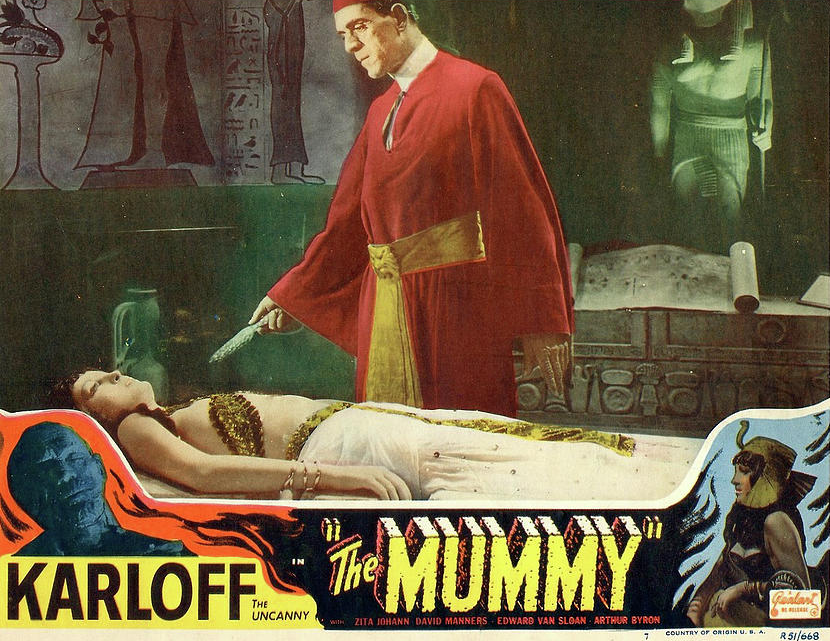
Years later, Imhotep reappears in Cairo under the alias Ardath Bey, disguised as a dignified, eerie scholar. His mission? To find the reincarnation of his lost love, now reborn as Helen Grosvenor (Zita Johann).
Their encounter sparks a chillingly tender connection — a love story that spans millennia, wrapped in bandages and bound by fate. But as Imhotep’s plan to reclaim her soul unfolds, the line between romance and obsession begins to crumble.
Boris Karloff: The Undying Presence
Fresh off his career-defining role as Frankenstein’s Monster, Boris Karloff returned to Universal in another physically demanding — yet deeply emotional — role.
His portrayal of Imhotep is one of quiet power. Beneath the heavy wrappings and haunting makeup (crafted again by the legendary Jack Pierce), Karloff conveys immense sorrow and longing. His measured speech, sunken eyes, and deliberate movements evoke a creature ancient and weary — not evil, but driven by love that death could not silence.
Karloff barely raises his voice, yet commands every frame. Where Frankenstein’s Monster was primal, Imhotep is refined — an immortal with the soul of a poet and the heart of a corpse.
Karl Freund’s Vision: Shadows of Eternity
Karl Freund’s direction transformed The Mummy into something far more than a typical horror picture. His background in German Expressionism — with its dramatic lighting and symbolic imagery — gave the film an atmosphere of dreamlike dread.
The sweeping sets, from Egyptian tombs to moonlit temples, feel ancient and eternal. Cinematographer Charles Stumar bathes everything in soft, funereal light, as if the entire film takes place halfway between life and death.
The pacing is deliberate, hypnotic — like the slow turn of sand through an hourglass.
Love, Death, and Rebirth
What makes The Mummy timeless is its emotional depth. Beneath the exotic trappings lies a story of love’s endurance beyond mortality. Imhotep’s desire to reclaim his beloved isn’t monstrous — it’s tragically human.
When Helen finally rejects his dark resurrection ritual, Imhotep’s calm façade breaks. As priests destroy the Scroll of Thoth, his thousand-year existence crumbles to dust, leaving only a mummy’s husk — and the echo of a love that outlasted time itself.
“My love has lasted longer than the temples of our gods… longer than the memory of men.”
Legacy of the Undead
The Mummy stands alongside Dracula and Frankenstein as one of the founding pillars of cinematic horror. It spawned countless sequels, remakes, and reinterpretations — from Universal’s 1940s adventure serials to the 1999 Brendan Fraser revival.
But none captured the spectral grace of the 1932 original — a film that wasn’t about terrorizing the living, but about mourning the dead.
Karloff’s Imhotep endures not as a monster of vengeance, but as a symbol of eternal devotion twisted by time.
Conclusion
As part of our October Monster Mash, The Mummy (1932) remains a haunting monument to old Hollywood’s artistry. It’s equal parts romance, tragedy, and horror — a film wrapped not just in bandages, but in sorrow and immortality.
In the flickering candlelight of the tomb, Imhotep’s voice still whispers across the centuries:
“Death is but eternal sleep — until love awakens it again.”
And for monster fans everywhere, The Mummy will never sleep again.